
Autonomous Fast Bot
A fully autonomous robot that avoids obstacles as small as furniture legs while travelling at up to 7 feet per second. It doesn't learn or memorize a course, so new courses and new obstacles don't affect it. All of its decisions are made in real time on five inexpensive processors working in parallel.
The problem
My first autonomous bot used one processor. To avoid small obstacles it had to stop and look. One processor can't scan many sensors and steer at speed, because each ultrasonic ping takes time and a fast vehicle covers a lot of ground during that time.
What I built
A partitioned architecture: four processors each watch one direction, and a fifth runs the motors. The forward board can interrupt the motor board immediately, while the others continuously report how much clear distance they see.
The result
A vehicle running at almost 5 mph that stays inside a "playpen" of small obstacles without stopping, for about $218 in processors and sensors.
Running the course with no map
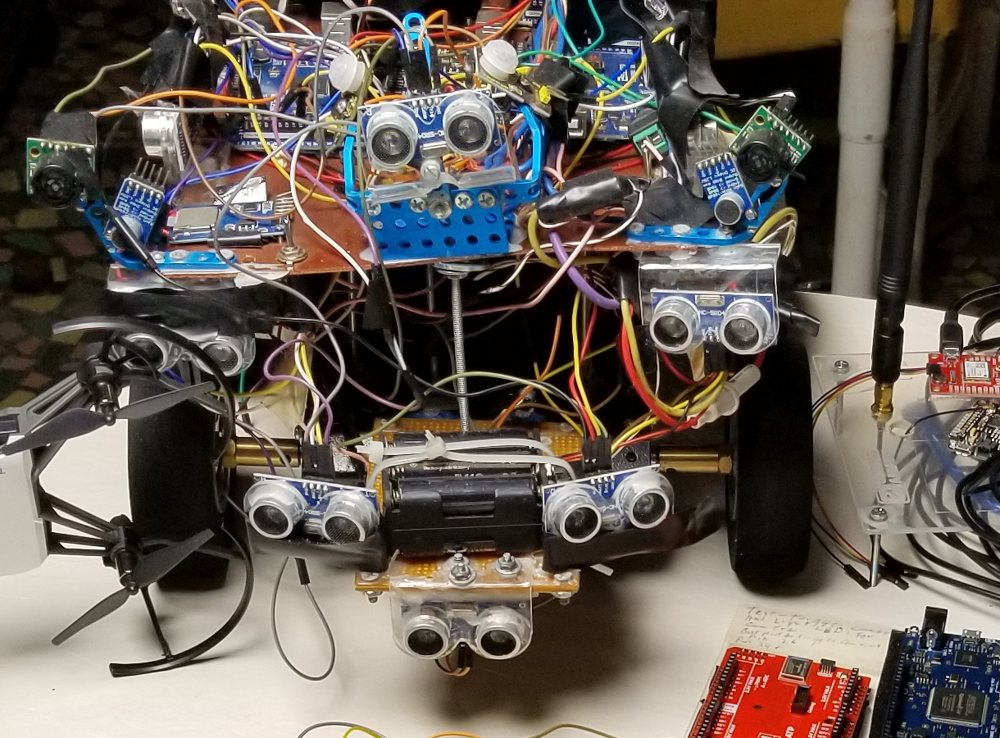


Partition the work to meet the timing
At 7 ft/s, a 30-inch detection distance leaves about 0.36 seconds to confirm the obstacle, signal the motor board, and get the motors to respond. That budget drove the design.
For the engineers in the room
Inter-processor signaling
- No serial protocol between the boards where speed mattered: each side board reports its clearance over three discrete lines coded as range bands (2–3 ft, 3–6 ft, over 6 ft)
- The forward board drives a hardware interrupt, so the motor board reacts without polling
- Each direction is scanned independently, so adding sensors doesn't slow the other directions
Why this was hard
- Getting the interrupt timing from the forward board and the motor-command timing correct took patience and a lot of trial and error
- Ultrasonic sensors must be fired so that they don't hear each other's echoes, which constrains the scan order
- Small obstacles such as pipe furniture legs return weak, intermittent echoes. Lessons from the earlier single-processor bot set the detection logic
From first generation to second
- Generation 1: one processor, stop-and-look. It met its requirements, but speed was limited by the sequential scan
- Generation 2: five processors and twice the sensors. Same design discipline, with the timing problem solved by architecture rather than by faster parts
Real-time systems on low-cost hardware
The lesson is general: when one processor can't meet the deadline, partition the problem so that each processor has a job it can always finish in time. The same approach applies to:
- Autonomous carts and warehouse or factory vehicles
- Multi-sensor data acquisition with hard timing limits
- Safety interlocks that must not wait on a busy main processor
- Low-cost prototypes before committing to custom electronics
Stack
Have a real-time problem one processor can't solve?
I design the architecture first, and then the timing works.
Start a conversation