
Pet Glasses
A real-time AI vision platform that reads an animal's emotional state, pain level and safety signals. Developed and trained on a PC with a webcam, it now runs on XREAL One Pro augmented-reality glasses with a Beam Pro: a mood tag floats above the pet in 3D and the glasses speak the result. A Brilliant Labs Halo version comes next.
The problem
Animals signal stress, pain and aggression in ways most people miss. Veterinary behaviorists have published rigorous coding systems for these signals, but nobody can apply them in real time while walking a dog or meeting a stranger's.
What I built
Four applications on one shared "brain". A detector on the glasses tracks the pet many times a second. Every few seconds a cloud backend runs frontier vision AI against encoded behavioral-science frameworks and returns a structured assessment.
The result
Running on the glasses: a world-anchored mood tag and ring that follow the pet, spoken results with safety warnings first, a Deep Dive panel with today's mood timeline, and switching between all four apps. Outdoor testing over cellular is under way.
Running on the glasses with Cabo
Photographed with a phone held behind the lens of the XREAL glasses, so the real dog and the AI overlay appear together as the wearer sees them. Click any image to see it full size.
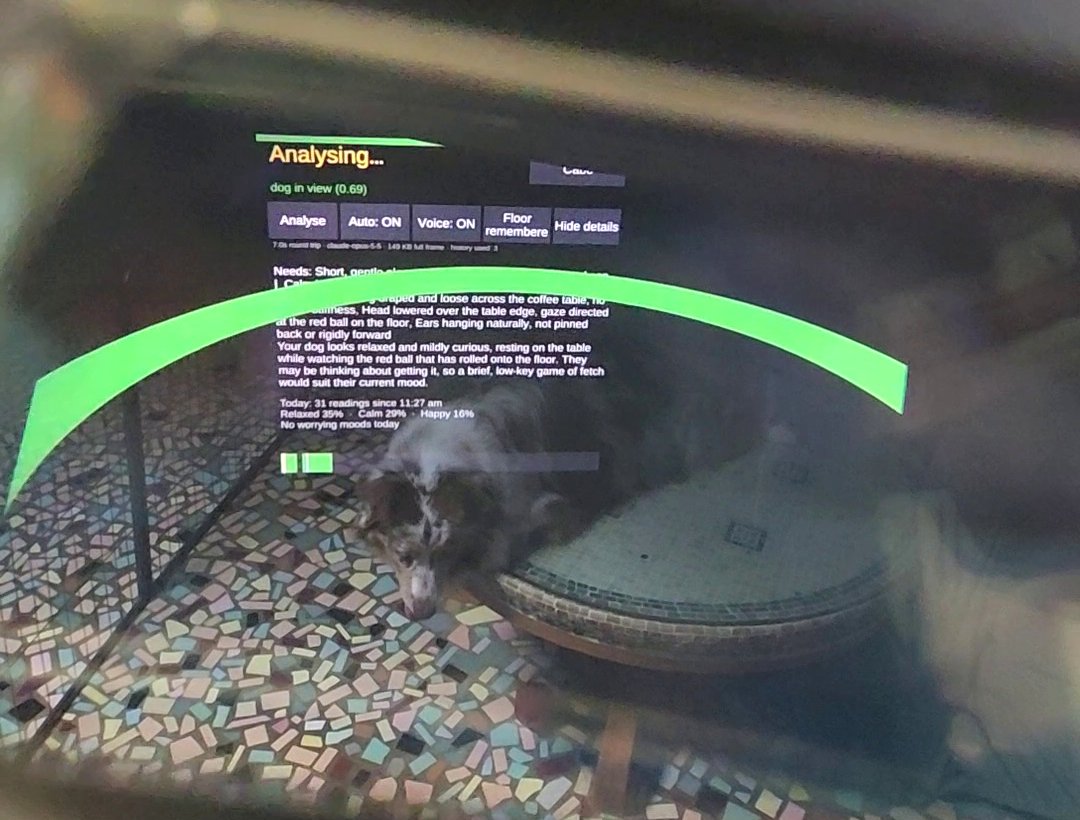
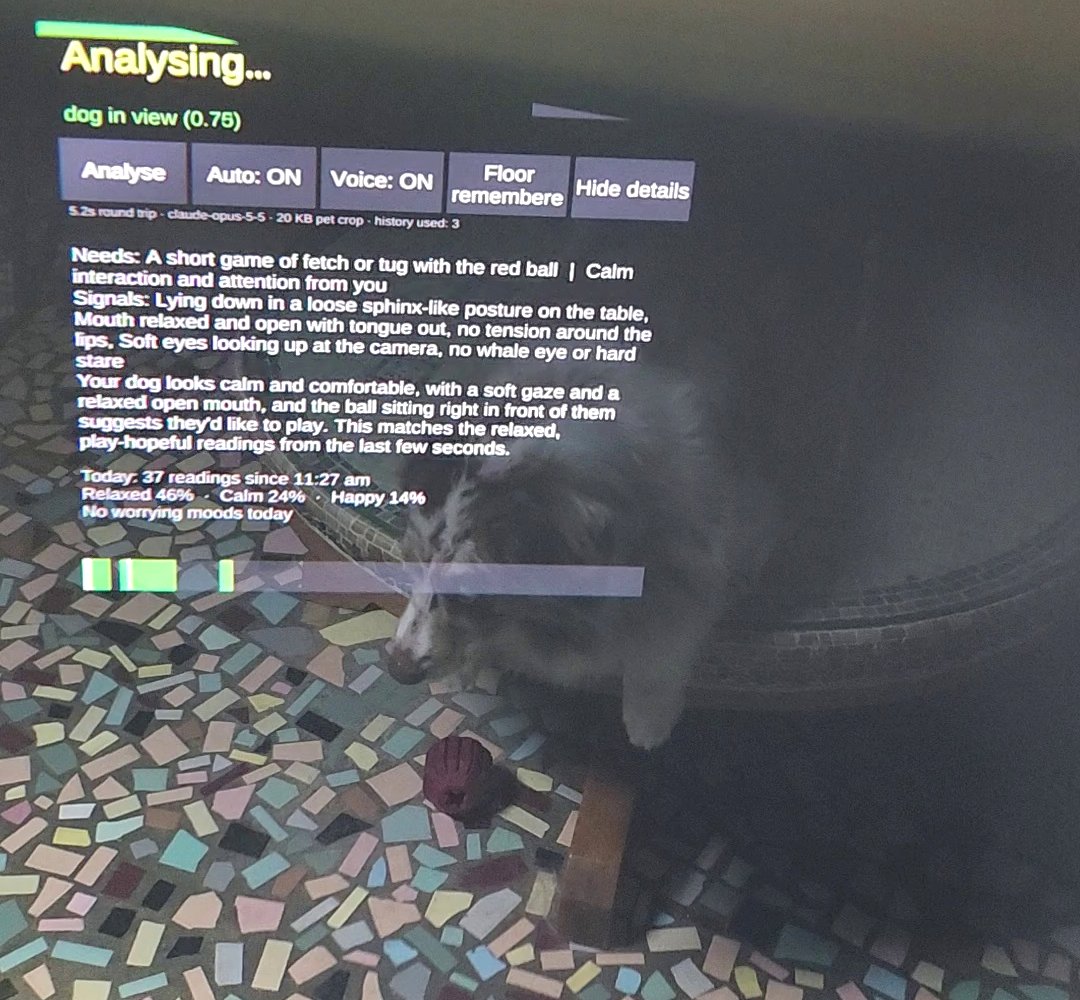
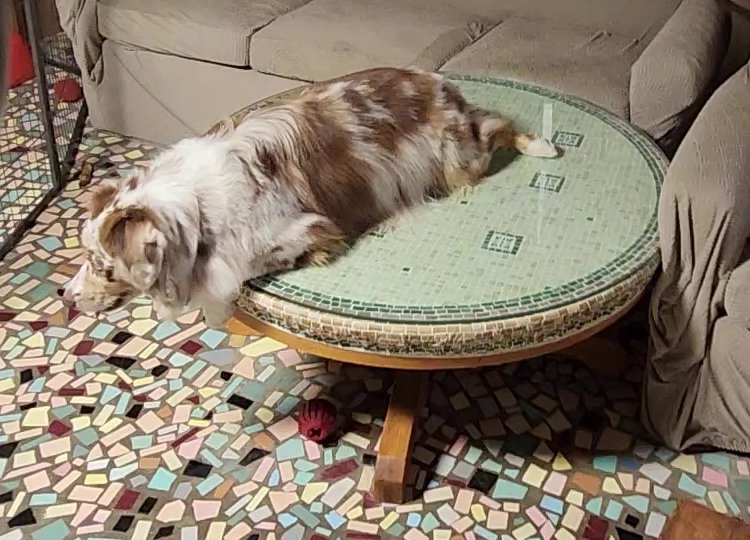
Four applications, one platform
Our Dog
Ten composite emotional-state profiles drawn from tail, ear, eye, mouth and posture signals, with practical care recommendations.
Other Dog
A four-level safety verdict for dogs you don't know, based on aggression and bite-risk signals, with urgent spoken warnings.
Our Puppy
Interprets puppy behavior in the context of developmental fear periods, so owners respond appropriately at critical ages.
Our Cat
The most complex app, combining three frameworks. It includes cat-specific safety flags such as belly-trap risk, overstimulation bites, and open-mouth panting as a medical emergency.
Train on the PC, deploy to the glasses
Each platform reuses the same knowledge bases and backend. Only the client changes.
PC + webcam
All four apps were built, trained and tested on a Windows PC with a Logitech C920. Inputs included live camera, an Android phone stream, test image sets and recorded video, with a dual-window HUD and speech.
XREAL One Pro + Eye + Beam Pro
A Unity app on the Beam Pro. It detects the pet in the Eye camera feed, anchors a mood tag and ring to it in 3D, speaks results, and opens a Deep Dive panel. Brought up on hardware in October 2026.
Brilliant Labs Halo
A lightweight client: Halo camera → phone → the same cloud backend → short text and speech. No 3D, but the same "brain" in glasses meant for all-day wear.
A fast loop on the glasses, a smart loop in the cloud
The vision AI responds every few seconds, but a tag that stays on a moving pet needs its position about ten times a second. So I split the work: a detector on the device answers "where is the pet?", and the cloud answers "how is the pet feeling?"
For the engineers in the room
Porting to spatial AR
- Kept the knowledge bases in Python, unchanged, behind a cloud API, rather than rewriting them in C# and ending up with two copies that drift apart
- The API key lives only on the backend. Nothing secret ships in the glasses app, and the backend requires device tokens
- The One Pro reports no floor planes to developers, so I added a one-tap "Set floor" calibration from eye height and placed the tag by casting a ray through the bottom of the pet's bounding box
- Converted the Eye camera's YUV frames to RGB on the GPU; colour accuracy was checked in the editor before the hardware arrived
- Measured on the Beam Pro: app at 32–36 fps, camera at 23–27 fps, 2.5–3 detections per second
- Sending crops of the pet instead of full frames cuts cost and cellular data, and gives better readings
Turning research into AI behavior
- Turned peer-reviewed coding systems into structured prompts with clinically meaningful output fields: pain score, belly-trap risk, urgent medical alert, developmental context
- Carried those fields all the way through the system, from AI output to HUD display to speech priority
Platform problems solved
- Replaced an unreliable text-to-speech library with direct Windows SAPI5 COM calls after diagnosing thread-affinity and stale-engine caching failures
- Found a gap where app-specific response fields were being dropped in the shared vision client
- Fixed environment variables overriding configuration, Python version incompatibilities, and video streams dropping over Wi-Fi
Delivery sequencing
- Built the shared infrastructure first, then the baseline dog app, the safety variant, the developmental variant, and finally the cat app with three combined frameworks
- Used an Android phone as an interim camera platform for real-world testing until the glasses arrived
- Built and tested the glasses app, camera pipeline and speech in the Unity editor before the hardware arrived, so bring-up went quickly
Expert knowledge, in real time
The core pattern is encoding a professional assessment framework and applying it to live video with vision AI. It carries over directly to:
- Veterinary, shelter and animal-welfare assessment
- Livestock and agricultural monitoring
- Industrial inspection and safety-behavior observation
- Field guidance on wearable or mobile devices
Stack
Have expert knowledge that should work in real time?
I can turn your domain framework into a working vision-AI system.
Start a conversation