
Dyslexia Assist Smart Glasses
A wearable reading aid. It captures text from the real world through a camera and re-renders it in a format tuned to the reader's type of dyslexia. It then keeps learning which presentation works best for that person. Developed and trained on a PC with a webcam, it will move to XREAL AR glasses and then to Brilliant Labs Halo.
The problem
Dyslexia isn't one condition. Phonological, visual-attentional, surface and mixed subtypes respond to different fonts, spacing and cues. Existing tools apply one fixed setting to everyone and only work on screens, not on the printed page in front of you.
What I built
A 20-module system covering seven engineering disciplines: real-time OCR, reversal detection, adaptive rendering, Monte Carlo simulation and a three-tier personal ML model. It runs on a webcam that stands in for smart glasses.
The result
A working, field-testable Phase 1 prototype, validated with live hardware at each stage and reaching 88–93% OCR confidence on real documents. This is work that would normally need a team of six to ten specialists.
What the camera sees, and what the reader sees
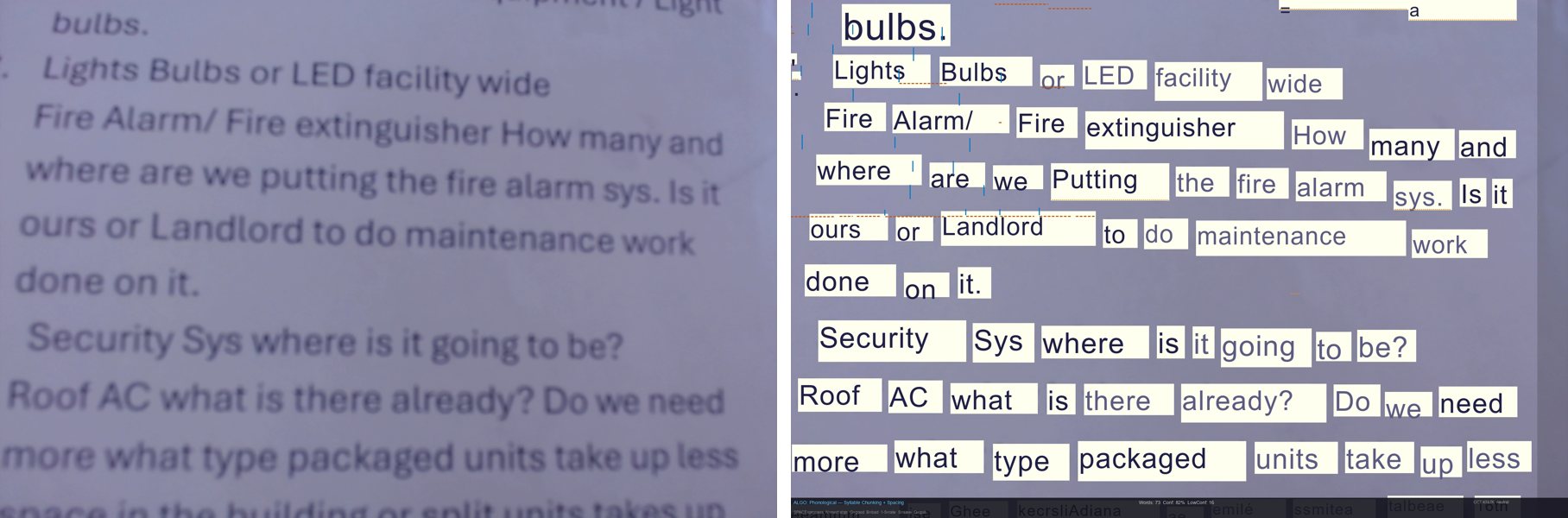
Train on the PC, deploy to the glasses
This follows the same path as my Pet Glasses platform, which already runs on XREAL glasses.
PC + webcam
All 20 modules built, trained and validated on a PC, with a Logitech C920 standing in for smart glasses. The ML models, Monte Carlo ranking and onboarding screener were all tuned here with live hardware in the loop.
XREAL One Pro + Eye + Beam Pro
Re-rendered text shown in the wearer's view, reusing the split design proven in Pet Glasses: fast capture on the device, with the intelligence and the reader's personal model in a backend.
Brilliant Labs Halo
Lightweight glasses for all-day use, with text-to-speech and simplified rendering. The codebase already includes a Halo interface module.
Five layers, twenty modules
I defined the interfaces between modules before writing any code, so all twenty integrated cleanly across three build phases.
Original technical contributions
Adaptive algorithm mixing
Instead of switching abruptly between display presets, the system blends them smoothly across six parameters with eased transitions, so the reader isn't jolted.
Multi-source evidence ranking
Four independent sources (past feedback, Monte Carlo prediction, ML output and subtype fit) are combined, with weights shifted automatically when a source is missing.
Personal ML without contamination
The model starts from a population-based prior and becomes fully personal as feedback builds up, and population data never leaks into the personal model.
Scene-aware vectorization
Each reading scene is described by 24 features: text properties, layout, lighting, the reader's profile and session age. The best rendering is matched to the scene and improves with use.
Dataset-validated reversal weighting
I analyzed a handwriting dataset of 25,976 samples. It showed that b/d reversals are 11.7 times more common than p/q, and that z/s is a confusion pair existing tools miss.
Wearable-first design
The whole pipeline from OCR to rendering targets under 100 ms on laptop-class hardware, ready to move to smart glasses.
Two AI builds, one evaluation
I developed this system in parallel with two frontier AI models, Anthropic's Claude and xAI's Grok, working toward the same goal. Then I compared what each produced. Choosing between AI outputs on evidence, not on headline numbers, is part of the engineering.
| Claude build | Grok build | |
|---|---|---|
| Scope | About 7,250 lines in 20 modules: OCR, overlays, speech, a profile for each reader, Monte Carlo tuning, Halo interface | About 790 lines: a vision-distortion simulator, display effects and one trained detector |
| Purpose | Help a person read printed text in real time | Mostly simulate dyslexic perception; the detector finds reversed letters in handwriting |
| Reversal detection | Checks recognized words for b/d and p/q letter swaps and was/saw-type word reversals, then marks them for the reader | A YOLOv8n object detector (normal, reversal, corrected) trained for 40 epochs on a public synthetic handwriting dataset |
| Evidence | Live camera tests: 88–93% OCR confidence on real printed pages | 99.5% mAP50, but measured only on synthetic validation images from the same generator; about a third of plain background was detected as letters |
| Decision | Chosen as the architecture | Kept as a candidate add-on |
Why the Claude build was chosen
- It covers the whole problem, from camera to reader, not a single model
- Its results were measured on real pages, not on data from the same generator it trained on
- It is grounded in published dyslexia research (for example, Shaywitz on letter reversals), so its choices can be checked and extended
What I kept from the Grok build
- The handwriting-reversal detector could support a separate use: flagging letter reversals in a child's writing samples for teachers or clinicians
- Before any use, it needs a test set of real handwriting and training on hard negatives to stop the background false alarms
- A near-perfect score on synthetic data is a starting point, not a result
For the engineers in the room
Research turned into design
- Took the structure of the subtype model and the ordering of presets from published neuroscience (Shaywitz 2003, Vellutino 2004) and the DysList error corpus
- Reviewed 12 public datasets and found that 52.7% of the "reversals" labeled in the best one were handwriting-formation errors, which don't apply to printed-text OCR. I excluded them before calibrating
- Population sampler built on published subtype prevalence (phonological 65%, visual-attentional 15%, surface 10%, mixed 10%)
Computer vision & OCR
- Tesseract OCR with confidence scoring; per-word bounding-box overlays; grouping into lines by Y position
- Two-pass median font sizing with outlier filtering; coordinates normalized to display scale
- Reversal detection across letter substitutions (b/d/p/q/n/u/z/s), whole words and transposed sequences
Where engineering judgment mattered
- Stopped the AI from seeding the personal model with population data, which would have quietly undermined personalization
- Found a missing interrupt handler that was silently throwing away session data, plus defects in validation logic and initialization
- Kept the architecture consistent across more than 100 development exchanges and repeated AI context resets. The project's design lived with me, not with the tool
Beyond dyslexia
The same pattern applies to many wearable and assistive products: camera → perception → personalized rendering → feedback learning.
- Low-vision and accessibility aids
- Heads-up displays for industrial work instructions
- Personalized learning and reading tools
- Any product that has to adapt to each user from small amounts of feedback
Stack
Building a wearable or assistive product?
I can take you from concept to a working, tested prototype.
Start a conversation